

Saturday, 30 May 2026
Wild Arts is a small but dynamic company that presents music and opera, touring from its base in Essex, under artistic director and founder Orlando Jopling. This year the company presenting a new production of Mozart’s The Marriage of Figaro with Danielle de Niese making her directorial debut and Orlando Jopling conducting. The cast features Jack Sandison as Figaro, Ellie Neate as Susanna, Timothy Nelson as Count Almaviva, Elinor Rolfe Johnson as Countess Almaviva and Abbie Ward as Cherubino. The work will be sung in a new translation by Danielle de Niese and Orlando Jopling, and accompanied by a ten-piece instrumental ensemble.
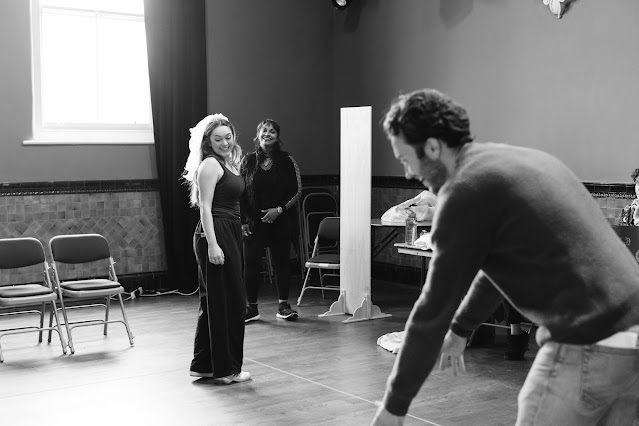
I recently went to join the company at rehearsals in South London where Danielle de Niese was working on the end of Act Two with Timothy Nelson, Elinor Rolfe Johnson and Ellie Neate, and afterwards I was able to find out more from Orlando Jopling.
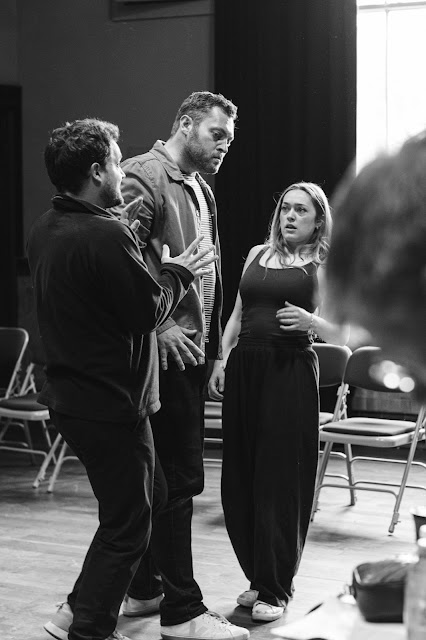
In rehearsal, it was fascinating quite how much stress Danielle de Niese placed on the words. Not only focusing on meaning and sense, but stress too and trying different readings, and it was illuminating to hear how different inflections affect the results. It was also clear that the translation itself was malleable with Danielle de Niese and Orlando Jopling working on alternative readings to achieve the right effect. For much of the scene (the moment from the Count’s entry) the attention was on the recitative and focusing on it as dialogue, but when the trio started Danielle de Niese was also paying great attention to the staging logistics, the farce elements.
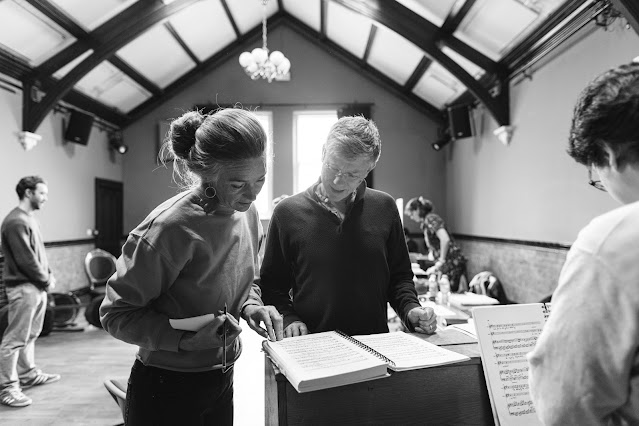
Afterwards, when I chatted to Orlando he commented that the singers were loving the rehearsal process and really believed in the work. Danielle de Niese has evidently come up with some interesting solutions to the challenges of staging various scenes, and Orlando describes the overall intention as being like good TV drama where details make so much difference. They are rehearsing the recitatives by speaking them so that the music comes in the natural rhythm of speech and pacing. Orlando’s aim is that people will forget that the cast is singing and that this will draw the audience into the story. They have also been doing a lot of work on the music of the recitatives themselves, thinking about the placement of the chords, what they mean and whether the chord precipitates the next line or references what has just happened. Orlando adds that Mozart and Da Ponte are so amazingly brilliant that the music gives the right shape to the drama with so much satisfying detail.
Wild Arts is a small but dynamic company that presents music and opera, touring from its base in Essex, under artistic director and founder Orlando Jopling. This year the company presenting a new production of Mozart’s The Marriage of Figaro with Danielle de Niese making her directorial debut and Orlando Jopling conducting. The cast features Jack Sandison as Figaro, Ellie Neate as Susanna, Timothy Nelson as Count Almaviva, Elinor Rolfe Johnson as Countess Almaviva and Abbie Ward as Cherubino. The work will be sung in a new translation by Danielle de Niese and Orlando Jopling, and accompanied by a ten-piece instrumental ensemble.
I recently went to join the company at rehearsals in South London where Danielle de Niese was working on the end of Act Two with Timothy Nelson, Elinor Rolfe Johnson and Ellie Neate, and afterwards I was able to find out more from Orlando Jopling.
In rehearsal, it was fascinating quite how much stress Danielle de Niese placed on the words. Not only focusing on meaning and sense, but stress too and trying different readings, and it was illuminating to hear how different inflections affect the results. It was also clear that the translation itself was malleable with Danielle de Niese and Orlando Jopling working on alternative readings to achieve the right effect. For much of the scene (the moment from the Count’s entry) the attention was on the recitative and focusing on it as dialogue, but when the trio started Danielle de Niese was also paying great attention to the staging logistics, the farce elements.
Afterwards, when I chatted to Orlando he commented that the singers were loving the rehearsal process and really believed in the work. Danielle de Niese has evidently come up with some interesting solutions to the challenges of staging various scenes, and Orlando describes the overall intention as being like good TV drama where details make so much difference. They are rehearsing the recitatives by speaking them so that the music comes in the natural rhythm of speech and pacing. Orlando’s aim is that people will forget that the cast is singing and that this will draw the audience into the story. They have also been doing a lot of work on the music of the recitatives themselves, thinking about the placement of the chords, what they mean and whether the chord precipitates the next line or references what has just happened. Orlando adds that Mozart and Da Ponte are so amazingly brilliant that the music gives the right shape to the drama with so much satisfying detail.
One of the advantages of the long tour is that it means that Wild Arts, whilst not able to pay lavishly, can offer the singers a decent chunk of money. And the sheer number of performances gives the singers, especially the Young Artists, the opportunity to learn to move from simply thinking ‘what next’ and really developing their performances. Orlando points out that if you only do three or four performances of a production, it all passes by in a flash thanks to sheer adrenalin. But a longer run gives the singers time to react to the stage and be in the moment, to play around with timings, see what makes the audience laugh and respond to this.
Orlando is keen for the opera performances to be approachable, and so they try and take away any element of the staging that puts the opera in a box, making it seem to be ‘over there’. English is very much the company’s preferred language, but Orlando is not dogmatic and does what’s right for that particular opera, though he admits that there is so much to be gained from performing in English as the audience is drawn into the story. Besides telling a story, Orlando wants his audiences to understand that opera is simply a brilliant night out at the theatre. The incredible story, with human characters who make mistakes and do ridiculously funny things (in the case of The Marriage of Figaro) allied to great music.
The show has to be flexible and respond to where it is, so any performance is about ‘that’ place and responds to ‘that’ audience. They are taking the best of theatre and thanks to having a long-running show are able to play with it and enjoy it.
For Wild Arts the summer is packed! From May to early September they are giving performances of An Evening of Opera, their 2026 incarnation of their regular opera programme. This year directed by Guido Martin-Brandis, it features four singers and a string quartet in arias and scenes from operas by Handel, Mozart, Puccini and Rossini, alongside songs from classic musicals by Rodgers and Hammerstein, Bernstein and Noel Coward. For these performances they intend to work in the same way as for the opera, concentrating on projecting the drama, with the intention of shedding new light on great music.
For The Marriage of Figaro they work with an ensemble of around ten players so every player is a soloist, and it becomes large-scale chamber music with a different dynamic between the players. The sound is more direct, less plush than with a full orchestra but Orlando feels that when they get it right it can be plangent. Orlando is also a cellist, and he comments that he loves playing in an orchestra, finding it wonderful how 80 or so players react. But experiencing chamber music making is intoxicating, considering what each player brings to the piece and the way it is brought to life by each player being a soloist.
Orlando points out that once an audience member is in the story, following the characters, the venue and stage matter less as the storytelling draws the audience in. As far as he is concerned it doesn’t matter what is on stage, you don’t need huge built sets as the stuff of the drama is in the interaction of the characters.
For The Marriage of Figaro they are working with a number of theatres, and several of these are ones that Glyndebourne Opera used to tour to. This means that their performances at these venues (including Norwich Theatre Royal, Malvern Festival Theatre, Cheltenham Everyman Theatre and Yvonne Arnaud Theatre, Guildford) are an important part of what they do. For these proscenium arch theatres, the orchestra is on stage and the performance is very much about the interplay between singers and instrumentalists to that the fourth wall is almost gone.
For the next few years, Orlando is very aware that Wild Arts needs to build these relationships. They have been thinking about performing Janáček’s Jenůfa, but have decided that next year they will tour Mozart’s Don Giovanni, so that theatres that have taken a chance on them can build their audiences. Then they will come to the challenges of Jenůfa in 2028.
Orlando regards Jenůfa as being essential for the company, showing that they have a range that encompasses serious opera and goes beyond entertaining comedy. The work presents the company with several challenges. For a start there is the issue of doing it in English. Janáček uses Czech speech rhythms in his music, but Orlando points out that whilst Janáček builds the orchestral texture from melodic fragment based on speech rhythms the vocal lines are freer. Also, between the first performances of the opera in Brno in 1904 and the later performances in Prague in 1916, Janáček changed a lot of the word setting so it is clear that even he was fiddling around with this. As long as the melodic shape is intact there is a way of doing it in English, so the language is intelligible whilst keeping the musical integrity. And Orlando is hoping to work with the same playwright who did the translation of Tchaikovsky’s Eugene Onegin for Wild Arts.
Though they will be using small forces, as usual, Jenůfa requires a bigger orchestra than their usual productions so in 2028 Wild Arts will be touring second production, Donizetti’s Don Pasquale, so that they have something portable to offer the smaller festivals. With an opera like Mozart’s The Marriage of Figaro, the company is able to cast the singers so that they are age-appropriate which means you get the perfect performers, something Orlando finds exciting. With Jenůfa it will be a bit more of a challenge, as singers will need the appropriate dramatic weight. But I sensed that this was a challenge that Orlando would relish.
Wild Arts’ production of Mozart’s The Marriage of Figaro, directed by Danielle de Niese & conducted by Orlando Jopling opens at Layer Marney Tower on 5 June 2026.
Full details of Wild Arts’ performances from their website, with a full calendar of performances