

BARRY MILLINGTON
February 17th, 2026
The ENO bring Kurt Weill and Bertolt Brecht’s opera to the Coliseum as a dystopia for our times
The eponymous fake utopia in Kurt Weill and Bertolt Brecht’s opera Rise and Fall of the City of Mahagonny is created because a discontented, disenfranchised populace finds “no harmony, no contentment”. Mahagonny is a promised land with beer and sex apparently freely on tap, a place where you can get anything if you can pay for it. Jeremy Sams’ lively translation (“such a hell hole”) and the libertarian slogans (“your choice, your freedom”) displayed prominently in Jamie Manton’s production point up the Trumpian resonances. And indeed the whole scenario could scarcely be more alarmingly relevant to our time – just as the genre of Zeitoper was intended to be.
For all the power of the dramatic punch it packs, however, there’s a potential for monotony in didactic theatre that this production doesn’t entirely manage to obviate. There are some inventive touches – not least the idiosyncratically accoutred, empowered sex-workers and the brilliantly conceived embodiment of a hurricane (choreographed by Lizzi Gee, danced by Adam Taylor) – but there are also long tracts of the first and second acts where the momentum sags.
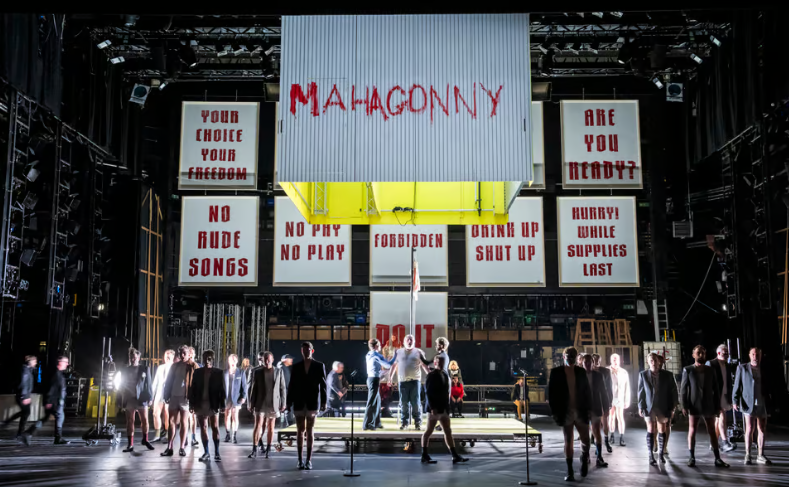
Milla Clarke’s set is a vast post-industrial urban wasteland extending the full width and depth of the stage. Lighting rigs and suchlike remind us, true to Brecht, that we’re also in the theatre, a fact brought home by D.M. Wood’s suitably harsh, all too literally in-your-face lighting, though interiors such as that in which the splendidly sentimental Maiden’s Prayer is played, virtuosically, by Murray Hipkin, are given a warmer glow. You could argue that empty spaces aptly reflect the vacuous existence of these pathetic souls, yet one can’t help feeling that a tighter focus might have had dramatic advantages.
Simon O’Neill brings his trenchant Wagnerian heroic style to bear on the role of the lead lumberjack, Jimmy MacIntyre, while Danielle de Niese delivers her celebrated Alabama and Benares songs with aplomb. Other excellent contributions from Kenneth Kellogg (Trinity Moses), Mark Le Brocq (Fatty the Bookkeeper), Rosie Aldridge (Leokadja Begbick) and David Shipley (Alaska Wolf Joe).
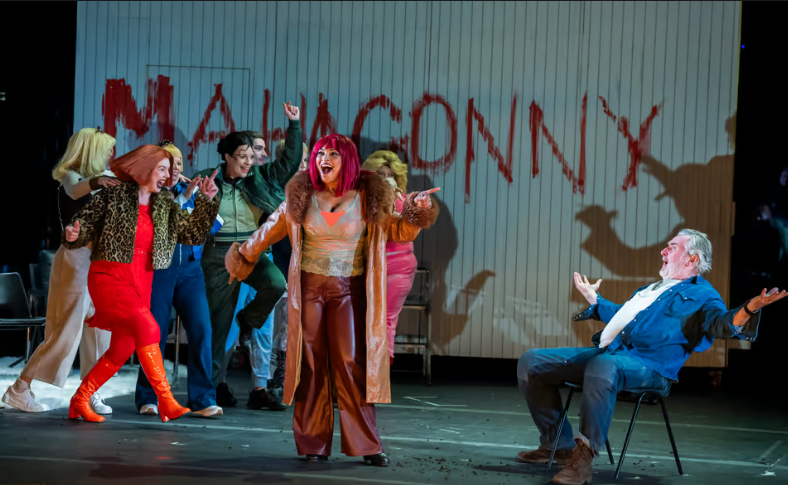
Weill’s austere score (for all its sensuous saxophones and folksy banjo) is projected by an admirable body of musicians and choral singers under the incisive baton of ENO’s Music Director Designate André de Ridder.
A court rules that no crime is more despicable than the lack of cash to pay for one’s pleasures and Jimmy is condemned to death. In the scenes in Act 3 leading up to his electrocution, and the aftermath, the production finally harnesses the musical and dramatic power of the work to thrilling effect.
Such a world of everyone for themselves presents an unmitigatedly bleak view of things. The one heart-warming aspect of it all was to experience this fine, if depleted, company pulling together under its new boss to give such a challenging work its best shot.