

Nicholas Kenyon
Chief Opera Critic
Nicholas Kenyon
17 February 2026 3:09pm GMT
The Rise and Fall of the City of Mahagonny reveals how a city founded on corruption tears itself apart
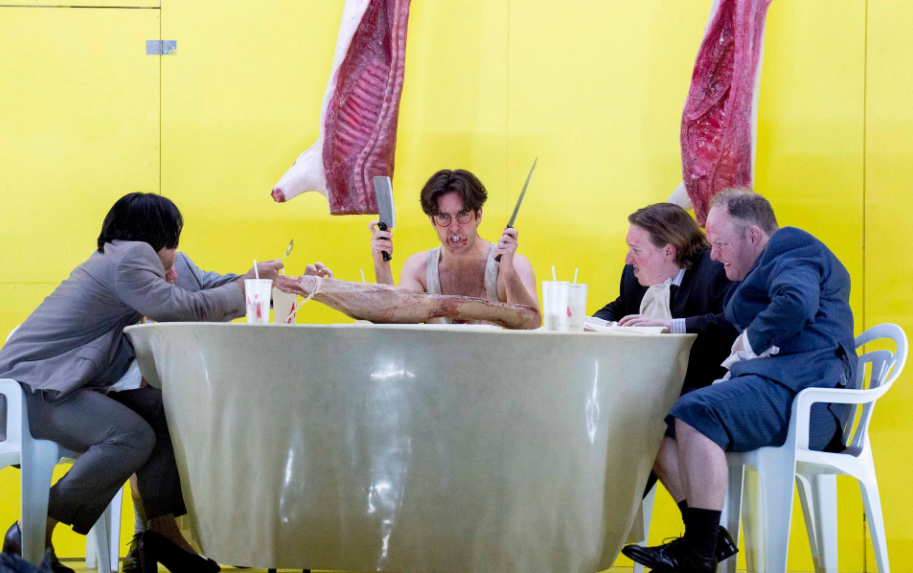
This hard-hitting, satirical 1930 opera by librettist Bertolt Brecht and composer Kurt Weill was deliberately intended to offend and even repel its audience. Rise and Fall of the City of Mahagonny tells the story of the creation of a new city in the American desert that celebrates corrupt values, and of its ultimate destruction. English National Opera’s messy new staging, directed by Jamie Manton, does not quite cohere. But with Weill’s pungent score, it certainly makes an impact, and provides an ideal first new production for ENO’s incoming music director, André de Ridder.
The city is, in Milla Clark’s designs, no more than a white box storage unit, wheeled onto the empty Coliseum stage and painted red with the name “Mahagonny” by its three criminal founders – Widow Begbick, Fatty the Bookkeeper and Trinity Moses – before eventually rising to reveal the boxing ring beneath, where the grisly denouement takes place. The opening is chaotic and not well managed, with the action poorly focused and lit, but the staging suddenly finds its grip and delivers some vivid scenes, notably when a rather topical hurricane threatens Mahagonny. (A tap dancer playing a weather forecaster galvanises proceedings as the storm looms, then suddenly diverts around the city.)
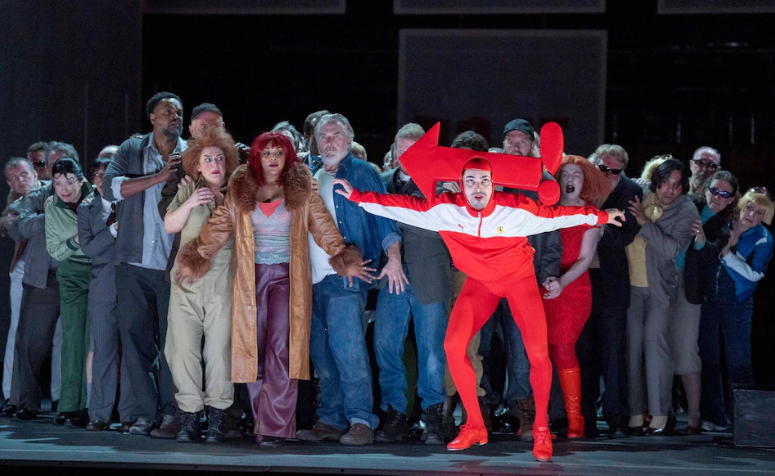
The text is sharply and wittily translated by Jeremy Sams, and the crude succession of vices portrayed is well evoked: excessive eating by Jack (Elgan Llŷr Thomas); obsessive sex by all; boxing, which causes Joe’s death (David Shipley); and drinking.
This is truly an ensemble show in ENO’s best traditions. Singer-actors Mark Le Brocq and Kenneth Kellogg are convincing as Fatty and Moses, while Rosie Aldridge is a strong Widow Begbick. But its success here depends on two outstanding leads: Simon O’Neill as the blustering, tragic Jimmy MacIntyre, who takes his lumberjacks from Alaska to settle in Mahagonny, but is eventually executed for the unforgivable sin of having no money.
His stentorian voice rings out boldly, and is matched by Danielle de Niese as Jenny Smith, the prostitute with whom he forms a fragile partnership. She is a full-voiced, flamboyant figure in her red wig (abandoned in the third act), not at all growly in the Lotte Lenya tradition, and her showbiz presence at the microphone ensures that great songs such as O Moon of Alabama make their heart-tugging effect. But she has no time for Brecht’s touching moment of sentiment when Jimmy is led to his death, and laughs cruelly.

The tension between the acute social criticism of Brecht’s text and the musically attractive showtunes of Weill’s diverse score has always been difficult to resolve. Here, conductor André de Ridder’s characterisation of Weill’s musical styles pays dividends, with powerful, sharply etched playing – a good omen for his future music directorship at ENO. In the end, this troubling piece manages to be both repulsive and attractive, and even the bleakness of the final choral tableau has an oddly cathartic effect.
Leave a Reply