

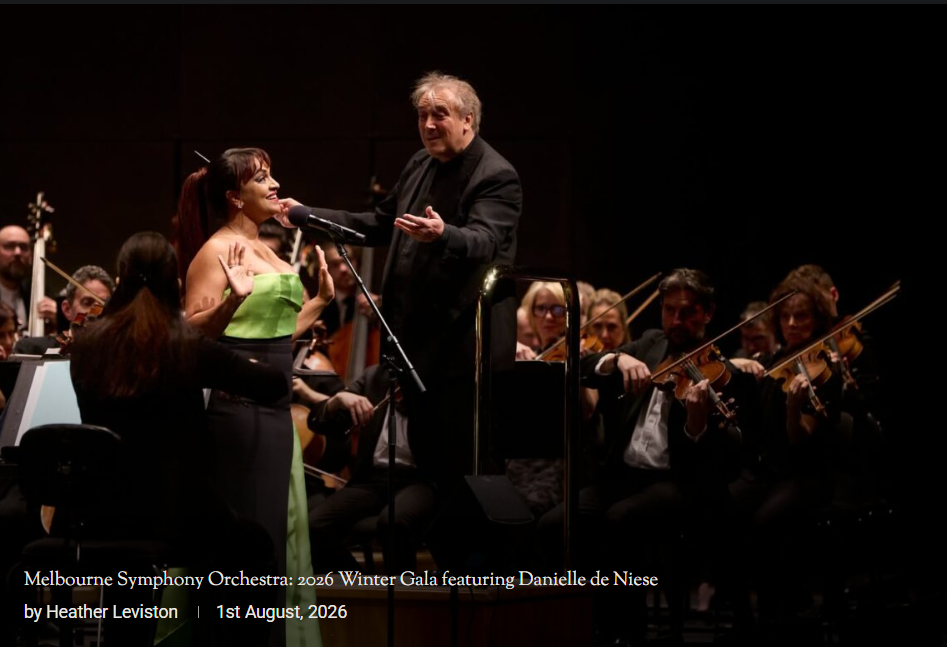
Just reading the list of items programmed for the Melbourne Symphony Orchestra’s 2026 Winter Gala is enough to quicken the pulse. Hits from works by twentieth century American musical theatre giants Kern, Porter, Gershwin and Bernstein plus orchestral suites by Bernstein and Ginastera that showcased the orchestra’s virtuosic talents were potent drawcards. Add a homegrown international opera star and you have an evening that is guaranteed to please.
As a Gala occasion, the stage itself looked as though the MSO might have entered a period of austerity. Not a single bloom or decorative piece of foliage in sight. The visual festivity was left to Danielle de Niese, who rose to the occasion by wearing a couple of dramatically vivid gowns – black and flowing swathes of lime satin before interval and Barbie pink with gorgeously ballooning sleeves after. De Niese’s personal beauty and glamour added further lustre, her dazzling smile on full beam.
Maestro Jaime Martín always brings a certain festive pizzazz to MSO concerts. As the orchestra’s Chief Conductor, he has maintained his popularity well past the “honeymoon period” with his warm personal approach and strong connection with audiences. He embraced the Latin American and musical theatre spirit of the program throughout, attentive and responsive to de Niese’s animated delivery.
The Overture from the operetta Candide (1956/1974) launched the concert at a cracking pace. Bernstein’s music is exhilarating, and the MSO provided an exuberant account of a score that travels from heraldic trumpets via chirpy flutes, a warm string melody and a snatch of the big soprano aria “Glitter and Be Gay” to some raucous brass, a fleet piccolo and a final dramatic chord that was spot on. Four minutes of precision playing set a festive tone for the evening.
It was a pity that we could not hear de Niese sing Cunegonde’s aria, but it may not have been quite in keeping with the other show songs. Sweeping onto the stage and blowing kisses to the orchestra and audience, she stood behind a microphone for a set that began with Bernstein’s “A Little Bit in Love” from Wonderful Town. It soon became obvious why this type of amplification was used, as it enabled greater control and subtlety when modulating tone and volume. There was something of the cabaret style at play as she almost crooned into the mic and moved with the music.
De Niese has an attractively warm soprano voice that reaches top notes with ease while maintaining a very lovely smooth tone. While she did adopt an American accent for these songs it was never intrusive, in fact, it was sometimes more English or neutral. She also took pains with clear diction. Adopting a less swooning style for “I Feel Pretty” from West Side Story, De Niese became a different character as Bernstein’s Maria. Then it was on to Gershwin with “I Got Rhythm” from Girl Crazy, where she clearly demonstrated that she did “got” it.
One of the less familiar works by George Gershwin followed: Cuban Overture (1932), which the composer described as “a symphonic overture which embodies the essence of Cuban dance”. The MSO percussion section came to the fore in this number (although not right in front of the conductor’s podium as apparently specified in the conductor’s note). The use of Latin American percussion instruments – Bongo, claves (wooden sticks), gourd and maracas – was a major innovation for Gershwin. Percussion drove the two outer dance-inspired outer sections framing the central bluesy idyll, and was hugely popular with the audience.
Now pretty in pink, de Niese began the second set of songs with Cole Porter’s “I Hate Men” from Kiss me Kate. Using chest voice strength for the opening statement the words rang with conviction. Unexpectedly, she was most restrained in her movements in this piece, making it all the more powerful. Her little gesture of reassurance to Martín for being exempt from the man hating was a nice touch. Porter’s “I Get a Kick Out of You” was a laidback contrast. De Niese conveyed the lyrics meaningfully with rhythmic flexibility and a final very well controlled diminuendo. Making excellent use of the microphone, De Niese began Jerome Kern’s “Can’t Help Loving That Man of Mine” very softly and slowly. It was an expressive rendition of this famous number from Showboat.
Of course, an encore was called for and, after a few words from the girl from Melbourne, she sang Gershwin’s “Summertime”, leading in with the most gorgeous tone and displaying the excellent breath control evident in all songs.
For his Variaciones Concertantes (1953), notable Argentinian composer, Alberto Ginastera, took inspiration from the music of the gauchos (cowboys). The guitar being the instrument of the pampas, Ginastera uses the guitar’s open strings pitches (E-A-D-G-B-E) as the basic structure, beginning with solo cello over a figure played by the harp. Within its 12 movements, flute, clarinet, viola, oboe and bassoon, trumpet and trombone, violin, horn, and even double bass are apportioned solos. Other movements are played by strings, winds and, finally, full orchestra. Each variation has a rhythmic basis of “malamabo” an Argentinian folk dance. It is a captivating piece and was performed with distinction by all principal player soloists. In his very informative pre-concert talk, Barkley Heuser remarked that the movement for clarinet was particularly difficult. David Thomas displayed his usual musical mastery but double bassist Jonathon Coco also deserved a special accolade.
As the concert began, so it ended – with Leonard Bernstein. West Side Story is possibly the most familiar and popular of all American musicals. Most members of the audience would have recognised the tunes as the nine diverse movements traversing the story unfolded in the Symphonic Dances.
As the Finale drew to a close with the sorrowful strains of “Somewhere (There’s a Place for Us)”, it seemed a strange way to end a gala performance. Trust Jaime Martín; he knew exactly what was needed, inviting the audience to join orchestra members with shouts of “Mambo!” in a reprise of that presto movement. The audience did join in – with gusto and surprisingly accurate timing after some conductor coaching. We left Hamer Hall in a suitably gala mood.