

Reviews
Jun 8, 2026
13:38
by George Hall
Layer Marney Tower, Essex
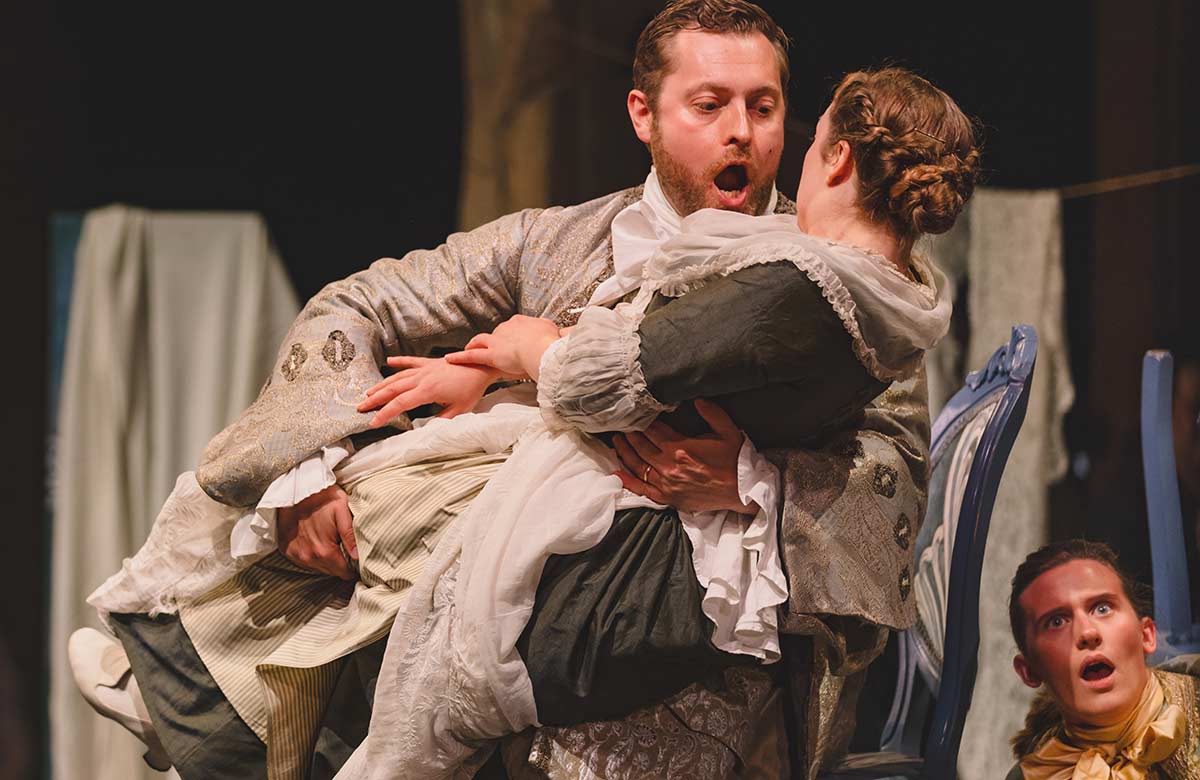
Wild Arts’ touring production of Mozart’s opera is hugely enjoyable
Mozart’s eternally popular comedy is the work chosen for this year’s Wild Arts summer opera tour. Between now and late September, it alternates with an evening of popular arias and songs at multiple venues from Essex to Cornwall, London to Lincolnshire. It’s a significant undertaking even on a purely logistical level; and the quality of entertainment is equally impressive.
Directing the production as her debut in that role is Danielle de Niese, one of today’s finest operatic sopranos, whose own performances combine musical and dramatic excellence, and who has clearly passed some of her skills on to a fine cast. This is not a full-scale Figaro: the chorus – whose role in the opera is minimal – has been dropped. Wild Arts’ founder and artistic director Orlando Jopling conducts an orchestra of 10 players – including himself at the keyboard – in his own clever arrangement of the score, skilful enough to disguise what has been left out. Individually and collectively, the instrumentalists make a highly positive impression, while Jopling’s spirited musical direction is a significant asset. He and De Niese also collaborate on a new English translation that makes a good case for opera in the audience’s language.
Visually, the staging is set in period, with elegant costumes by designer Laura Jane Stanfield, who is also responsible for a pragmatic touring set – a handful of boxes, a few chairs and a clutch of screens. Together, these suggest the four locations required and sit comfortably on a platform that can easily be transported.
Leading the cast are bass-baritone Jack Sandison’s superbly voiced, dramatically engaged Figaro, his whole vocal range in perfect order, pitted against baritone Timothy Nelson’s tonally resplendent, if unusually angry Count Almaviva. Pinpoint accurate, Ellie Neate aids her husband-to-be in outwitting the Count with the sterling aid of fellow soprano Elinor Rolfe Johnson’s touchingly presented, emotionally neglected Countess. Their famous Letter Duet is a highlight.
Abbie Ward brings appealing vocal decoration to precocious teenage boy Cherubino, while mezzo companion Olivia Ray makes Marcellina – determined to marry Figaro herself until she learns (to her surprise) that she is, in fact, his mother – a good deal more sympathetic than usual. Well-crafted doubling-up brings versatile bass Timothy Dawkins success both as a proud, vengeful Bartolo and the household’s clodhopping gardener Antonio, while tenor William Searle demonstrates similar accomplishment in switching from the castle’s chief intriguer Don Basilio to the Count’s legal advisor, Don Curzio. Eleanor O’Driscoll, meanwhile, makes a good deal of the opportunities granted to the Count’s illicit squeeze, Barbarina. Altogether, the staging is hugely enjoyable and well worth catching on its travels.