

Written by Nicholas Kenyon
August 23, 2026
*****
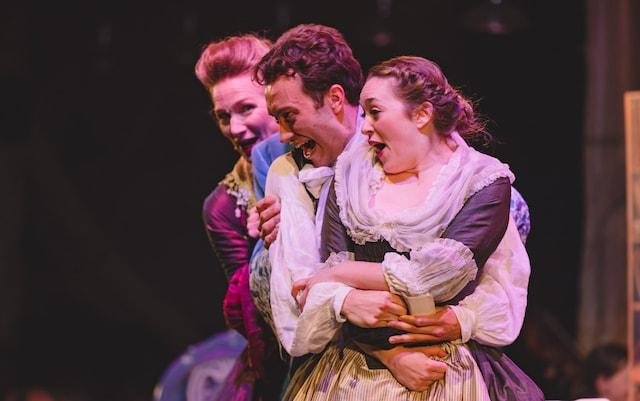
This pocket-sized Marriage of Figaro, which marks the directorial debut of star soprano Danielle de Niese, has been touring small venues across England during the summer, before arriving at the larger arena of Opera Holland Park. It's a brilliant, witty version of Mozart's and Da Ponte's eternally fresh comedy, with a freshly translated libretto and a reduced orchestration. The follies of the day, in which the servants of the Almaviva household, Figaro and Susanna, attempt to get married, frustrating the interference of the Count with the help of the Countess, can scarcely ever have unfurled with such immediacy or such pointed humour. It may be tiny in scale, but as a result it is wonderfully immediate.
Conductor Orlando Jopling and de Niese have jointly translated Da Ponte's libretto, making it up to date and full of bumptious rhymes; you may miss the Italian sounds of the text, but the meaning is crystal clear. Jopling's reduced orchestration is for 10 players, here expanded to match the size of the Holland Park theatre, but retaining single instead of double wind instruments, and involving Jopling himself at an electric piano, deftly managing the recitatives.
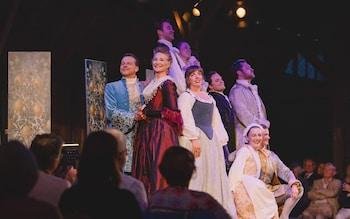
A stripped-back set brings the fun and farce of Figaro wonderfully close to the audience. Credit: Lucy Toms
However, the spareness of the production results in a few losses – there is no chorus, which results in an awkward cut to the Act Three wedding celebrations, no dressing-up aria for Susanna in Act Two, and the often-expunged arias of Act Four are also absent. The scenery is scant, but that sometimes increases the humour: for example, the doors of the Countess's boudoir, which play such an important part in Act Two, are flimsy hanging curtains, and so we have to suspend our disbelief when they are locked and unlocked. The page Cherubino (Abbie Ward, lanky and excellent) jumps out of the window and stumbles into the audience, apologising profusely. A few boxes of sheets and clothes and one miniature tree are all that are needed to help this scenario of plotting and confusion.
De Niese, herself an accomplished Susanna in past productions of this opera, clearly has the ability both to draw strong characterisations from her protagonists, and then mould them into something strikingly theatrical. Mozart's own favourite ensemble (so he claimed) where Figaro (the ever-lively Jack Sandison) discovers that Marcellina (a commanding Olivia Ray) who wants to marry him is actually his mother, is vividly choreographed.
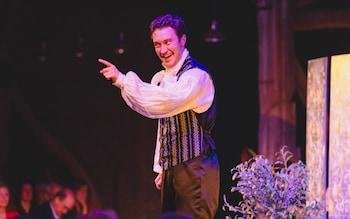
Figaro is played by Jack Sandison. Credit: Lucy Toms
Jopling's flexible music-making allows both Ellie Neate's crisp, energetic Susanna and Elinor Rolfe Johnson's put-upon Countess to make their full emotional effect; Timothy Nelson's angry Count blusters, Timothy Dawkins's pompous Bartolo doesn't quite keep in time (but who cares), and Eleanor O'Driscoll's sparky Barbarina is eager to be part of the fun.
It is a pleasure to see the tiny orchestra (led by Eleanor Corr) so visibly enjoying themselves, while playing with rhythmic suppleness. This is an absolute model of how to do small-scale classic opera with a contemporary edge. I feel sure Mozart would have cheered.
Touring in September to the Minack Theatre Cornwall, Titsey Place, Norwich Theatre Royal, and Birmingham Rep. Information: https://wildarts.org.uk/