

Written by Joshua Kosman
July 19, 2026
Festival Napa Valley celebrates its 20th year with the world premiere of Jake Heggie and Gene Scheer’s “The Judgment of Paris” opera at Charles Krug Winery in St. Helena on Saturday, July 18.
Most operas are written to be repertory items, performed in one theater this year and somewhere else the next.
But “The Judgment of Paris,” the ebullient and delightful new comic one-act by San Francisco composer Jake Heggie and librettist Gene Scheer, is so resolutely site-specific that its world premiere on Saturday, July 18, at the Charles Krug Winery in St. Helena practically counts as an art installation. There’s no other venue in the world where the piece would make as much sense.
This is no accident. “The Judgment of Paris” was commissioned by Festival Napa Valley to celebrate its 20th anniversary, and by implication the region’s entire winemaking culture. The music is alternately joyous, tender, cinematic and virtuosic, but the opera’s underlying spirit is that of a victory march.
The great triumph it celebrates took place 50 years ago, when a competition in Paris pitted flights of French reds and whites against their Napa Valley counterparts in a blind taste test. To their shock and chagrin, the panel of French experts found that they had chosen California offerings as the top wines in both categories.
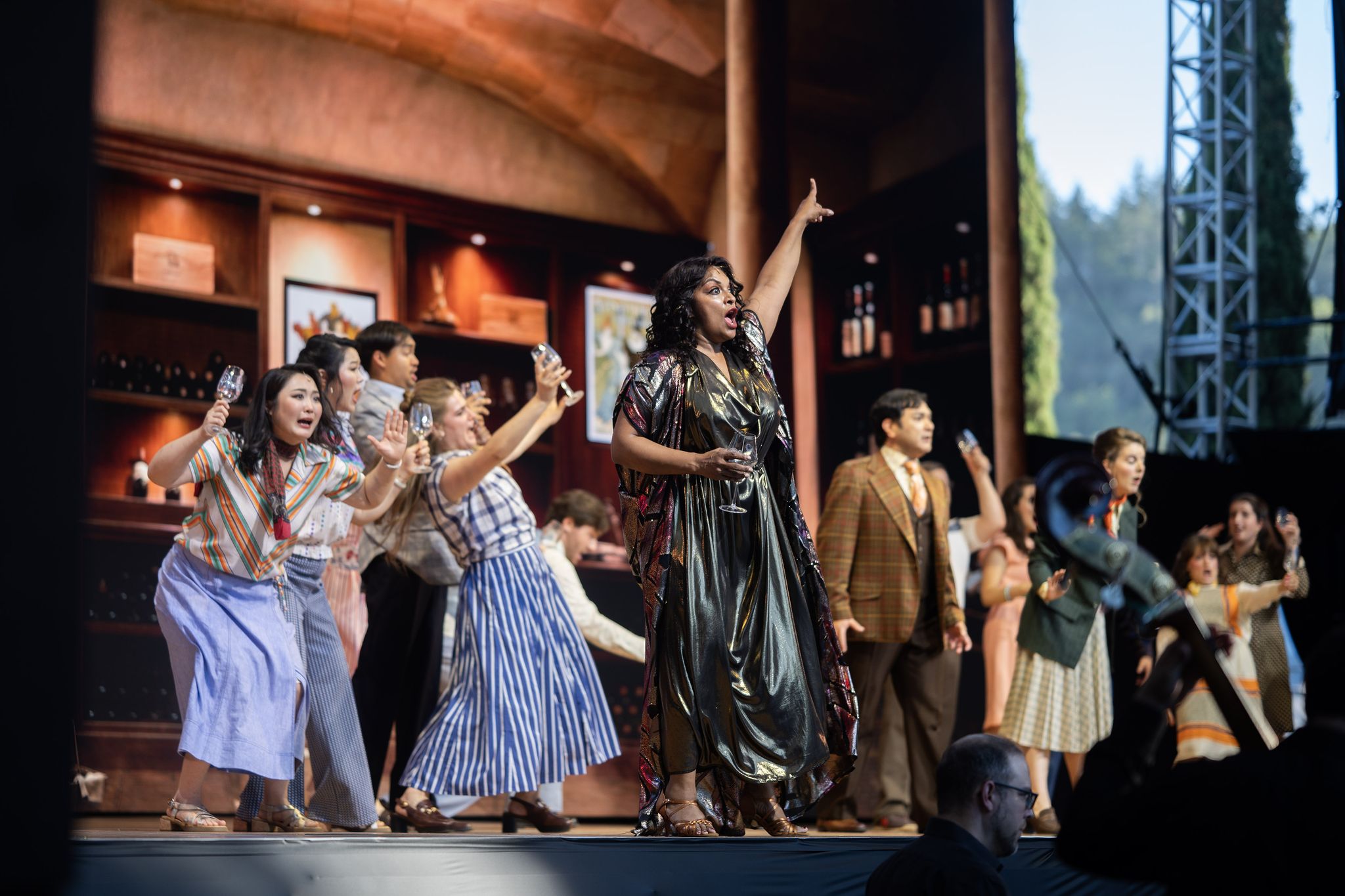
Danielle de Niese, center, and the cast of “The Judgment of Paris” perform at Charles Krug Winery in St. Helena on Friday, July 18, during Festival Napa Valley.
This outcome, reported by American journalist George Taber in a short but memorable four-paragraph item in Time magazine, is credited by wine historians for having upended truisms about the primacy of French viniculture and given Napa Valley vintners a new respectability on the world stage.
For some of the patrons at Saturday’s premiere (which, alas, marked the opera’s only performance), the connection to this 1976 event was personal as well as professional. When a presenter asked for a show of hands of vintners who’d been in the business when the competition took place, a scattering of six or eight hands immediately went up.
The late Napa vintners Mike Grgich and Warren Winiarski, whose respective wines were crowned in Paris that day, both appear as characters in the opera, and the first appearance of each was greeted with widespread applause.
But the allure of Heggie and Scheer’s creation ranges far beyond the specifics of time and place. It’s a marvelous musical and theatrical invention, infused with the comic spirit of Offenbach, and it tells its story with a perfect balance of seriousness and breathless farce.
Danielle de Niese, left, as Venus, and Quinn Kelsey as Bacchus perform “The Judgment of Paris” with other cast members during Festival Napa Valley at Charles Krug Winery in St. Helena on Saturday, July 18.
The title, with its allusion to Greek mythology, comes from Taber’s article, but the opera takes it and runs with it. Venus and Bacchus, the deities of love and wine, form the framing narrative. He’s a French wine fundamentalist, while she’s so bored and desperate for variety (both in and out of the bedroom) that she inspires the whole taste-off just to rattle him out of his rut.
Once we get to the competition itself, the historical events almost do the writing for Scheer. The judges arrogantly and unknowingly disparage the French wines as supposedly negligible products of weak California viniculture, and vice versa.
There’s even a ready-made villain in the person of Odette Kahn, the doyenne of French wine writers, who appears as a sort of oenological Miranda Priestly, the imperious fashion editor from “The Devil Wears Prada.” Heggie, who always understands the assignment, gives her ferocious strands of high-flying coloratura to sing, making the entire role practically one long mad scene.
The rest of the score, which was conducted by Berkeley native Kent Nagano, proved equally enchanting, and the starry cast delivered it all with fervor and panache. The orchestral writing for the opening scene, set atop a storm-ridden Mount Olympus, evokes memories of mid-century MGM sound tracks.
Conductor Kent Nagano leads the orchestra during the world premiere of the opera “The Judgment of Paris” during Festival Napa Valley’s 20th anniversary celebration at Charles Krug Winery in St. Helena on Saturday, July 18.
Heggie renders Paris as a shadowy, history-rich realm, while California appears as a series of bright, airy choruses. The score is replete with marvelous pieces of invention — a choral toast to the glory of wine, a tango theme for the lovemaking of Venus and Bacchus, and much more.
Soprano Danielle de Niese and baritone Quinn Kelsey brought a wonderful combination of earthiness and grandeur to their godly roles. When people talk about of the Greek and Roman deities as being reflections of human foibles, this is what they mean.
Soprano Brenda Rae was a fierce and frankly scary presence as Odette Kahn. Tenor Nicholas Phan and mezzo-soprano Simone McIntosh gave amiable, tuneful performances as Steven Spurrier and Patricia Gallagher, the real-life organizers of the competition.
Director Jean-Romain Vesperini staged the piece with all the bubbly charm it required, especially in an outdoor venue where nuance has a tendency to get lost. The backdrop’s arrays of picture postcards signaling travels to Paris and Napa were note-perfect. The roller-skating attendant bringing Venus and Bacchus yet another bedside bottle was a glorious touch. (Once you see this in action, you realize that opera directors have been far too neglectful of the theatrical possibilities of roller skates.)
Once or twice, the opera’s celebration of viniculture shades into something a bit more servile, like the obligatory celebration of a royal patron in operas of the 17th and 18th centuries. I’m not quite sold, for instance, on the premise of Venus’ gorgeous aria comparing the works of Shakespeare, Michelangelo and choreographer Alvin Ailey — as “genius touching the divine” — to a good bottle of wine, but that may be because I don’t drink enough.
Overall, though, “The Judgment of Paris” is all pleasure, the work of two terrific creators throwing off an 80-minute comic bauble with hidden depths, and making it all look incredibly easy.
Now someone needs to get to work on organizing a second performance.
Joshua Kosman is the Chronicle’s classical music critic emeritus.