
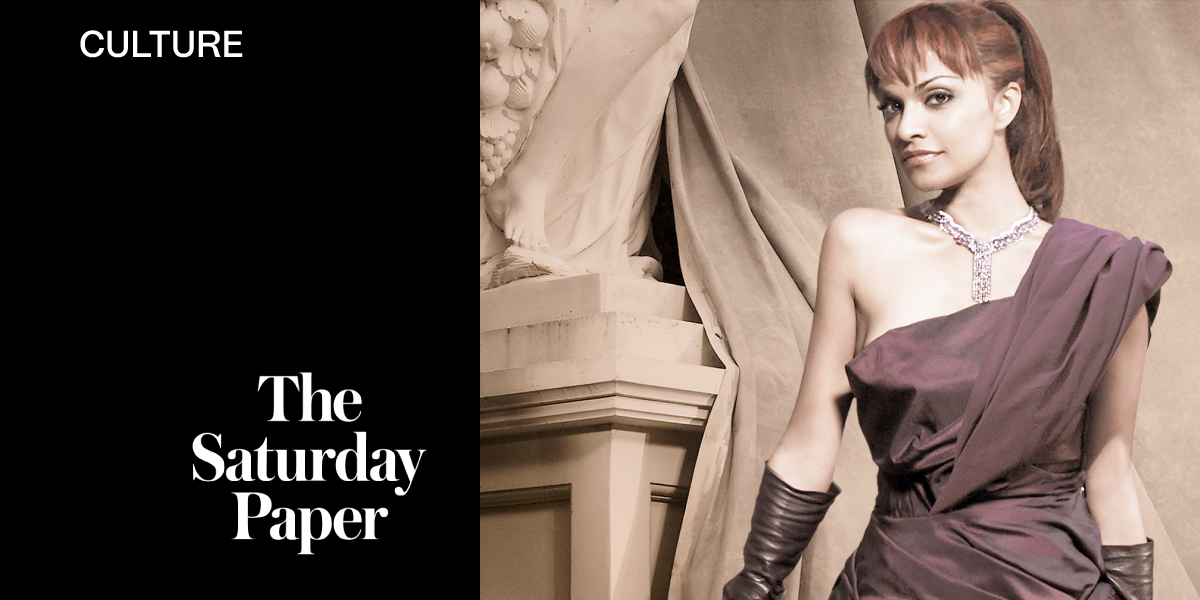

It takes a few attempts to pin down Danielle de Niese for this interview. She is 17 hours removed from Melbourne, and the call finally lands in the only window when our clocks agree: her afternoon and my early morning.
Wearing a summery dress and a cheerful smile, she takes the video call from a busy cafe in California. De Niese is at the Festival Napa Valley, where she’s taking the stage for the world premiere of Jake Heggie’s new opera, The Judgment of Paris – a piece commissioned for the festival’s 20th anniversary that’s built around the 1976 blind wine tasting, when the valley’s upstart vintages famously bested the French. It is, she tells me, “very exciting”.
Despite the excitement, it has been a difficult few weeks. She arrived in Napa with one of her children when tragedy struck. “I came out with my daughter and unfortunately my dad passed away just a few weeks ago. I had come out for the festival, but then I left to go to Los Angeles for a day to bury my dad.”
She speaks with the steadiness of someone who has shared the news many times. Her family has since joined her. “I brought my mom and my brother back up with me so we could all grieve as a family together.”
Her father was 73 and recently retired when he fell ill, she tells me, and had spent three years fighting multiple system atrophy, a rare, incurable disease that slowly dismantles the body’s autonomic functions.
“He was healthy his whole life,” she says. “I wouldn’t want him to stay here and have his symptoms get any worse, but it was getting pretty bad.”
The loss has had a profound impact on her close-knit family. “We miss him tremendously because we’re only a family of four taking this kind of journey to America.”
Her husband and son flew out from their home in the United Kingdom once the school term ended, and the family reconvened around her while she worked. “The rest of my family are having a wonderful time and I’m popping into work to do the world premiere and then coming back home to a full house.”
Despite her personal loss, the show must go on. De Niese is now preparing to come home for some concerts with the Melbourne Symphony Orchestra – she was born in Melbourne in the late 1970s to Sri Lankan parents.
She says she was performing from as early as she can remember. “I was that kid. I’ve seen pictures of me where I’m just kind of holding forth in the kitchen, you know, like four years old, five years old, just full of personality, vibrant, present. I’m just lucky my parents spotted it.”
Her parents enrolled her in singing and dancing classes, which young de Niese not only enjoyed but excelled at. “And the teachers were very responsive to my parents saying, ‘She’s ahead of the class’, or ‘We’re putting her in the adult class’, or ‘She’s leading the dancers in the concert.’
“They were just always confirming what my parents had felt when I was small and developing as a child, that I had a real knack for performing.”
That knack landed her on one of the biggest stages in Australia at the time: Young Talent Time . “I was at the Johnny Young Talent School. I’d already been taking the lessons there,” she recalls. “I would have gone for the audition process with the Whitney Houston medley. And then, when I was picked to be Talent Discovery of the Month – they had one per month – I did the medley on telly. And then, out of the 12 finalists of the 12 months, they picked one to do the Talent Discovery of the Year.”
There are a few clips on the internet showing a nine-year-old de Niese in a yellow dress her mother had sewn, with a matching scrunchie, hair pulled up in a ponytail and bangs, belting out “Tomorrow” from Annie in the final. It’s evident even then that she was meant for big things. She went on to win the competition. “That was the greatest talent in Australia under age 16, in all fields,” she says. “I just have amazing memories of that time. Young Talent Time was the biggest thing at the time. I mean, it was like, I don’t know, like FIFA is right now.” The win came with $5000 and a baby grand piano.
Although she was already a “triple threat” who could sing, act and dance, her mother decided to seek out classical training for the young de Niese, a decision that entirely changed the trajectory of her career. “There was nobody who would take me on,” she says. “Everyone thought, She’s way too young, she just needs to wait . But [my mother] found one teacher who would take me on with the Victorian State Opera. She was called Amanda Colliver. And she said, ‘I’ll teach her.’ ”
Even as a child, opera was always a dream. De Niese remembers at eight years old drawing a picture of herself alone on an opera stage in a “poofy dress with big stage wings”. Surrounded by children who could sing and dance, she recalls thinking: “None of them can do this. This is special. I think I want to do this.”
Soon she reached the limit in Australia for opportunities for child performers and her parents began to look further afield. “There were no programs for under 18s at the time,” she says. “I would have just had to sit on my hands and wait for eight years to enter the Victorian College of the Arts.”
“The thing is, the arts is a massive, gratifying dopamine hit, but it’s a long game. It’s not a short game.”
Her parents “wrote to every conservatory in America to ask for advice” and they all offered to take her on with a host family. Her parents were not keen on sending de Niese so far alone, so the whole family relocated to the United States when she was 10 years old and she was enrolled at the Colburn School in Los Angeles. “They did mostly instrumentalists, but they kind of made a vocal department to teach me privately. I’m very proud of the training I had there. That was from 10 to 18.”
The family’s decision to relocate paid off. De Niese’s career reads like a highlight reel of success after success: a Los Angeles Opera debut at 15, an Emmy at 16, a Broadway debut in Les Misérables at 18, a role in Ridley Scott’s Hannibal in 2001. In 2012, she collaborated with LL Cool J at Carnegie Hall to bring together the worlds of hip-hop and opera, which earnt de Niese the nickname bestowed by The New York Times Magazine : “opera’s coolest soprano”. This year she received an Olivier award – the highest honour in British theatre and drama – for her contribution to opera.
I’m curious about the discipline required to sustain a close to four-decade international career. De Niese puts it down to her training.
“There are things in our mainstream cultural consciousness that have changed around that training … things like social media and screens, and the amount of other things with much more short-term dopamine hits, creating a culture where we seek gratification all the time,” she says. “The thing is, the arts is a massive, gratifying dopamine hit, but it’s a long game. It’s not a short game. It’s not a you-get-something-right-now if you take three lessons. You need to take 300. And then when you’ve taken 300 lessons, you could get really good.”
She has watched that tension play out with her children, aged 11 and five. “I’m very aware of when that moment might hit, where the initial euphoria of entering into something that you enjoy and are sparked and intrigued by, it will fade and it will be replaced by that long, persevering journey,” she says. “I will be there to guide them through that. I think I’m going to be a parent who will say, ‘Okay, I know that you feel piano is boring, but we’re going to try to stick with it.’ ”
She describes trying to show her son, who plays the piano, a glimpse of where a piece is heading. “Having an understanding of what a finish point is, even if that finish point is not Arthur Rubinstein. Showing them some examples of people who got that far and also allowing them to feel great achievement by getting one step into that journey, I think is quite important.
“Like I noticed with my son that if we just slog away practising slowly, he can’t hear where the future is, and so we try to get one piece really good and we’ll play it faster. We’ll play it one hand each and we’ll play it faster where I can join in with him so he can hear, this is where we’re going, this is where we want to get to. When you can see what’s at the end of the tunnel, it’s a little easier to stick it out, I think. That’s my personal experience.”
De Niese is also quick to make the distinction between performing for an audience and performing to be applauded. “I want to be known as a storyteller,” she says. “If I were to perform only because then I got validation from the public… I think that would be very treacherous.” The audience’s response, she says, is simply part of the exchange and not the point of it. “I leave everything there on the stage and I give it out and then what they receive is what they receive.”
The stage is bringing her back home. While her Australian accent has long been replaced with a transatlantic twang, she still holds her birthplace dearly. She was here last year when she took on the title role in Opera Australia’s Carmen . This month, she returns to the city that first put her onstage: Melbourne.
She will be singing across two nights as part of the Melbourne Symphony Orchestra’s Winter Gala, where she’s taking on the American songbook repertoire of Leonard Bernstein, George Gershwin, Jerome Kern and Cole Porter, which she defines as her “second identity”: the musical theatre lineage that runs alongside opera. “It’s a real chance for Australians to hear me do something that I actually do a lot,” she says, “that brings together all of my musical theatre experience.”
She describes chief conductor Jaime Martín, with whom she’s collaborated internationally, as a kindred spirit onstage. “He’s a conductor who conducts from his heart,” she says. I ask what the nine-year-old in the yellow dress who dreamt of being in opera would think now. “I think she’d just go, ‘Wow, you did it’, because that’s what I dreamt of when I was a kid. I wanted to be a famous opera singer.”